


Open sourceApache-2.0Agent Network
Run any model. Protect what matters.
kLLM runs open models from a curated library on SGLang and vLLM. A sealed model produces no useful output without its key. Pull a model, unlock it with a key, and run it.
# Pull a model from the library and chat with it on a local engine
$ kllm pull qwen3:8b
$ kllm run qwen3:8b
Install from source today; pip install kllm follows the first tagged release. Installation
How it works
Three steps from download to API
- 01
Pull
Download a model from the kLLM library or Hugging Face to the local store. A manifest records the hash of every file.
- 02
Unlock with a key
A sealed model is locked on disk and produces useful output only with its key. Apply for the model keys of official sealed models, or generate a key and seal models locally with the open-source tool.
- 03
Run
kLLM starts SGLang or vLLM on 127.0.0.1 and opens a chat interface. The same server exposes an OpenAI-compatible API.
Model library
Transformer models across modalities
Sealing requires a validated implementation for each architecture. The library expands as the team adds architectures; unsupported models can be requested.
Language
Dense and mixture-of-experts models: Qwen3, Qwen3-MoE, Qwen2.5 and Llama 3.x, including FP8 checkpoints.
Image diffusion
Diffusion transformer for image generation: Z-Image, with a client-keyed mode.
Video generation
Video and audio generation: MiniMax H3 FL2VA. Sealed under perm, it measured the same end-to-end time as plain serving (8 steps, one A40).
Official sealed models
Popular open models, sealed ahead of time
The kLLM team seals selected public models at a pinned revision, locks the weights and publishes each one under its own model key. With the key, anyone can check a published model against its public base with kllm verify.
- Qwen3-8B-kllmRolling out
Qwen/Qwen3-8B @b968826d9c
Text · Apache-2.0 · client-keyed
- Qwen3-4B-Instruct-2507-kllmRolling out
Qwen/Qwen3-4B-Instruct-2507 @cdbee75f17
Text · Apache-2.0 · client-keyed
- Qwen3-32B-kllmRolling out
Qwen/Qwen3-32B @9216db5781
Text · Apache-2.0 · client-keyed
- Qwen2.5-7B-Instruct-kllmRolling out
Qwen/Qwen2.5-7B-Instruct @a09a35458c
Text · Apache-2.0 · client-keyed
- Llama-3.1-8B-Instruct-kllmRolling out
meta-llama/Llama-3.1-8B-Instruct @0e9e39f249
Text · Llama 3.1 Community License · client-keyed
- Qwen3-30B-A3B-Instruct-2507-kllmRolling out
Qwen/Qwen3-30B-A3B-Instruct-2507 @0d7cf23991
Text (mixture of experts) · Apache-2.0 · client-keyed
- Qwen3-30B-A3B-Instruct-2507-FP8-kllmRolling out
Qwen/Qwen3-30B-A3B-Instruct-2507-FP8 @5a5a776300
Text (mixture of experts) · Apache-2.0 · client-keyed
- Z-Image-kllmRolling out
Tongyi-MAI/Z-Image @04cc4abb7c
Text to image · Apache-2.0 · client-keyed
- Z-Image-Turbo-kllmRolling out
Tongyi-MAI/Z-Image-Turbo @f332072aa7
Text to image · Apache-2.0 · client-keyed
MiniMaxAI/MiniMax-H3 @42ed227ee7
Text and images to video with audio · MiniMax H3 Community License
Engines
Stock engines, unmodified
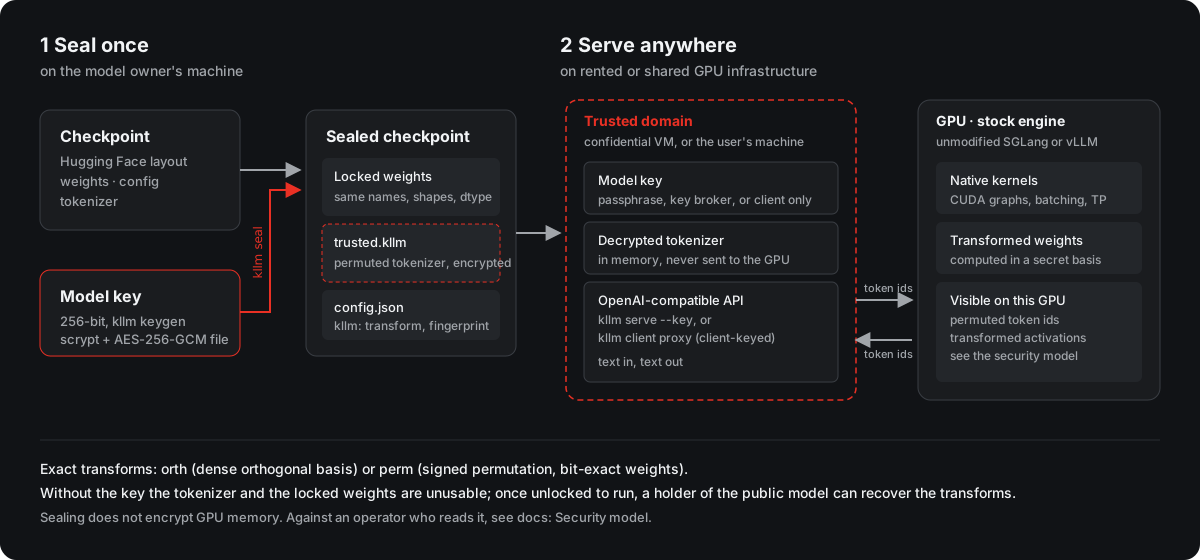
kLLM is a layer on top of the inference engine, in the way LMCache is for KV caches. It does not replace or fork SGLang or vLLM. A sealed checkpoint keeps its file names, tensor names and shapes, so the engine loads it with its native model classes and kernels.
- SGLang
- 0.5 or later; measured on 0.5.21
- vLLM
- 0.11 or later; measured on 0.31.0
Measured results
Same hardware, close to the same speed
On the same GPUs as stock vLLM, SGLang or Ollama, kLLM adds a degree of privacy protection. In every measured configuration served with a key on one A40, sealed output throughput was never more than 0.3% below plain serving on the same engine.
- Largest measured drop in sealed output throughput, keyed serving at concurrency 16
- 0.3%
- Largest measured drop in sealed output throughput, keyed serving at concurrency 16
- Sealing and locking Qwen3-1.7B (4.1 GB) on one A40 server, catalog build
- 36 s
- Sealing and locking Qwen3-1.7B (4.1 GB) on one A40 server, catalog build
- Throughput cost of client-keyed mode under vLLM at concurrency 16
- 7%
- Throughput cost of client-keyed mode under vLLM at concurrency 16
Sealed throughput matched plain serving
Output throughput at concurrency 16, tok/s · plain, perm, orth · one NVIDIA A40 48 GB, bf16, 1024 input / 128 output tokens
First-token latency increased by up to 7.2 ms
Change in median time to first token versus plain serving, concurrency 1, ms · perm, orth · same hardware and conditions
Conditions: NVIDIA A40 48 GB; SGLang 0.5.21, vLLM 0.31.0; bf16; 1024 input / 128 output tokens; GPU shared with another tenant's light job; single runs, no variance reported. Throughput in some rows was higher when sealed, which is attributed to noise on the shared host. All published results
Combined with confidential GPUs, transformed tensors can cross nodes without an extra encryption step, a design target for disaggregated serving.
Security
Security as stated design targets
Without the key, recovering prompts or weights is intended to require an academic, high-cost attack beyond the reach of commercial adversaries, with recovery cost far above generation cost. These are design targets. The measured limits of the current release are published in full.
Deployment profiles · trust boundaries, not scores
- Official catalogModel keys
Without the model key, the published files compute nothing useful and cannot be matched to the public base. A key holder can reproduce them from the public base with kllm verify.
Does not claim: Confidentiality between key holders, who share each model's key, or protection of the weights once unlocked to run: the base models are public.
- Private SealOpen source
Without the key, the locked checkpoint computes nothing useful and cannot be matched to the public model it derives from. Cloud logs hold permuted token ids.
Does not claim: Protection of the copy the cloud runs, which is unlocked, from a cloud that reads GPU memory or analyses the weights.
- Attested CPUEnterprise
Key and decrypted tokenizer stay in confidential-VM memory. Users can check that TLS terminates in the attested VM.
Does not claim: GPU memory protection. Not yet validated on TEE hardware.
- Confidential GPURoadmap
Not implemented.
Locking protects the files, not a running model: whoever runs the model holds the unlocked weights. Outside a confidential VM, kllm serve --key is a development mode with no protection from the host. To an operator who reads GPU memory, user text reduces to a substitution cipher over tokens.
Research
Published research
The kLLM team publishes research on confidential transformer serving. The perm transform extends STIP's permutation approach to grouped-query attention, RoPE, MoE and FP8; the research systems themselves are separate from what kllm seal ships today.
- ACM SIGCOMM 2025SCX: Stateless KV-Cache Encoding for Cloud-Scale Confidential Transformer ServingMu Yuan, Lan Zhang, Liekang Zeng, Siyang Jiang, Bufang Yang, Di Duan, Guoliang XingDOI 10.1145/3718958.3750509Code
- NDSS 2026STIP: Three-Party Privacy-Preserving and Lossless Inference for Large Transformers in ProductionMu Yuan, Lan Zhang, Yihang Cheng, Miao-Hui Song, Guoliang Xing, Xiang-Yang LiDOI 10.14722/ndss.2026.230035
Get started

Model keys
Apply for model keys
Each official sealed model on Hugging Face has its own model key. One application can cover several models. The team reviews applications and sends the keys of the approved models with instructions. Every approved holder of a model's key holds the same key, so it is not a confidentiality boundary.
Apply for model keysEnterprise
kLLM Enterprise
Day-zero support for newly released models, models sealed under a key issued for the customer alone, enterprise deployment and maintenance, and attested key release with a gateway.
Contact the team